Coming to grips with the great Digital Revolution: Part 1 – Describing some parts, but never the Elephant

Describing Parts of the Elephant 

Blind

There is that familiar parable of the blind men and the elephant, originating from the Indian subcontinent. Let me use the Jain version to make my point;

“A Jain version of the story says that six blind men were asked to determine what an elephant looked like by feeling different parts of the elephant’s body. The blind man who feels a leg says the elephant is like a pillar; the one who feels the tail says the elephant is like a rope; the one who feels the trunk says the elephant is like a tree branch; the one who feels the ear says the elephant is like a hand fan; the one who feels the belly says the elephant is like a wall; and the one who feels the tusk says the elephant is like a solid pipe.

A king explains to them: “All of you are right. The reason every one of you is telling it differently is because each one of you touched the different part of the elephant. So, actually the elephant has all the features you mentioned.[2]””

I use this story to make this point, that everyone who understands the promise and possibilities of the emerging technologies in Artificial Intelligence, Robotics, Internet of Things, etc can only talk about some trends and patterns – no one can credibly predict how all these forces will converge and how the changes and the revolution they bring about would look like. In a sense, we are all describing the various attributes of the Elephant, but none of us have seen the Elephant in it’s glorious entirety. It’s here though, it’s so big and it’s presence cannot be ignored.

The Second Machine Age 

One framework I like to use when considering the problem is the idea of platforms, that there are certain technological breakthroughs, when they occur,  suddenly accelerate progress from the regular slow drudgery of linear growth to an almost instantaneous burst of exponential growth.

Screen Shot 2015-06-05 at 3.03.04 PM

In their influential book “The Second Machine Age: Work, Progress, and Prosperity in a Time go Brilliant Technologies“, Messrs Brynjolfsson and McAfee chart this phenomenon. The Economist sums up the book very well;

“Innovation has always driven advances in mankind’s standard of living, from agriculture to electricity. Information technology, the authors argue, is quantitatively and qualitatively different. It is, thanks to Moore’s law, exponential: its effects, barely perceptible for the first few decades, are turning explosive. It is also digital. Formerly complex tasks can be mastered then reproduced and distributed at almost no cost. Finally, it is recombinant, merging separate, existing innovations and innovators through networks and crowdsourcing.”  

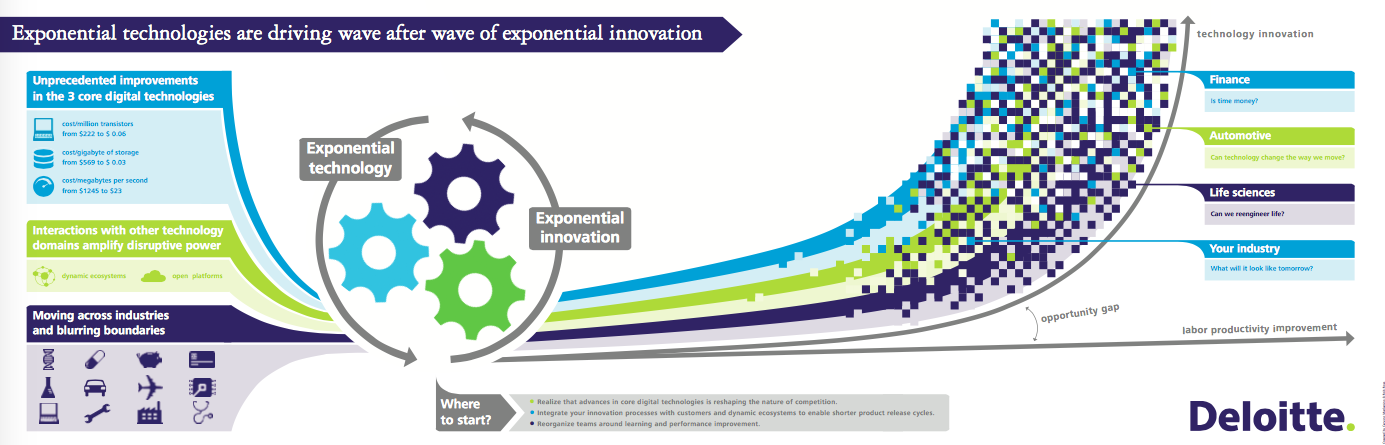
These spikes occur in a phenomenon that some have come to call Platform moments. Deloitte explains this as a series of events;

1. The cost to performance ration of the 3 building blocks, compute, storage and bandwidth has improved exponentially over the last few years
2. Innovation is built on these building blocks and they drive up value and competitiveness, so as more and more attempt to leverage this phenomenon, the effect of no 1 is further amplified
3. Innovations start to coalesce and combine to form platforms and ecosystems that then drive innovation as a whole, bringing exponential change and disruption
Screen Shot 2015-06-05 at 3.58.16 PM

So in a nutshell, the slow upward trajectory of progress of individual components begin to build up into platforms that can suddenly launch us into accelerated progress that seems so sudden, and out of nowhere. It is with this framework that I will attempt to describe some parts of the elephant and then predict some of the possible platforms and spikes that could come, but by no means will I ever even imagine to pretend to be able to describe the elephant. That would be as absurd as being an old Mongolian solider on my horse (before the invention of the automobile) trying to predict the future of electric cars.

COGNITIVE COMPUTING is not ARTIFICIAL INTELLIGENCE

chappie-poster-sdcc

Sentience vs Artificial Intelligence 

There is Hollywood induced baggage to the term Artificial Intelligence, which assumes switching on a computer or robot with Sentience. Wikipedia defines Sentience as;

Sentience is the ability to feelperceive, or experience subjectively.[1] Eighteenth-century philosophers used the concept to distinguish the ability to think (reason) from the ability to feel (sentience). In modern Western philosophy, sentience is the ability to experience sensations (known in philosophy of mind as “qualia“). In Eastern philosophy, sentience is a metaphysical quality of all things that requires respect and care. The concept is central to the philosophy of animal rights, because sentience is necessary for the ability to suffer, and thus is held to confer certain rights.”
http://en.wikipedia.org/wiki/Sentience

The conventional definition of AI though when you key in “define Artificial Intelligence” in google is;

Artificial Intelligence is the theory and development of computer systems able to perform tasks that normally require human intelligence, such as visual perception, speech recognition, decision-making, and translation between languages.”

It is a gigantic leap from creating rational sub routines and emulating of human cognitive functions to having a machine that is sentient. That’s why to avoid doubt on a popular level, I rather use the term Cognitive Computing then AI.

The mystery of consciousness

So the AI we have today, is still a long way of from the sentient beings from our SciFi tradition. Our systems at present produce models and processes that simulate human cognition and function in very specific scenarios. Sometimes we anthropomorphise human interfaces and systems to make the user feel as if they were interacting with a sentient being. As for having a sentient machine, it will only happen after we have solved the great mystery of ‘human consciousness’, though many today question if it really exist or of if it is just an illusion of our internal dialogue machine that is constantly emulating consciousness to enable our self of self and others and then communicate with one another, because we are fundamentally a social species. The solution in the movie transcendence was to image various states of consciousness in an FMRI and reproduce it digitally despite not being able to define what it was, and then have to fused to a state-of-the-art Cognitive Engine.

http://goo.gl/BHXxtJ

A 4th “I” for IBM’s “The 3 I’s of Smarter Content”

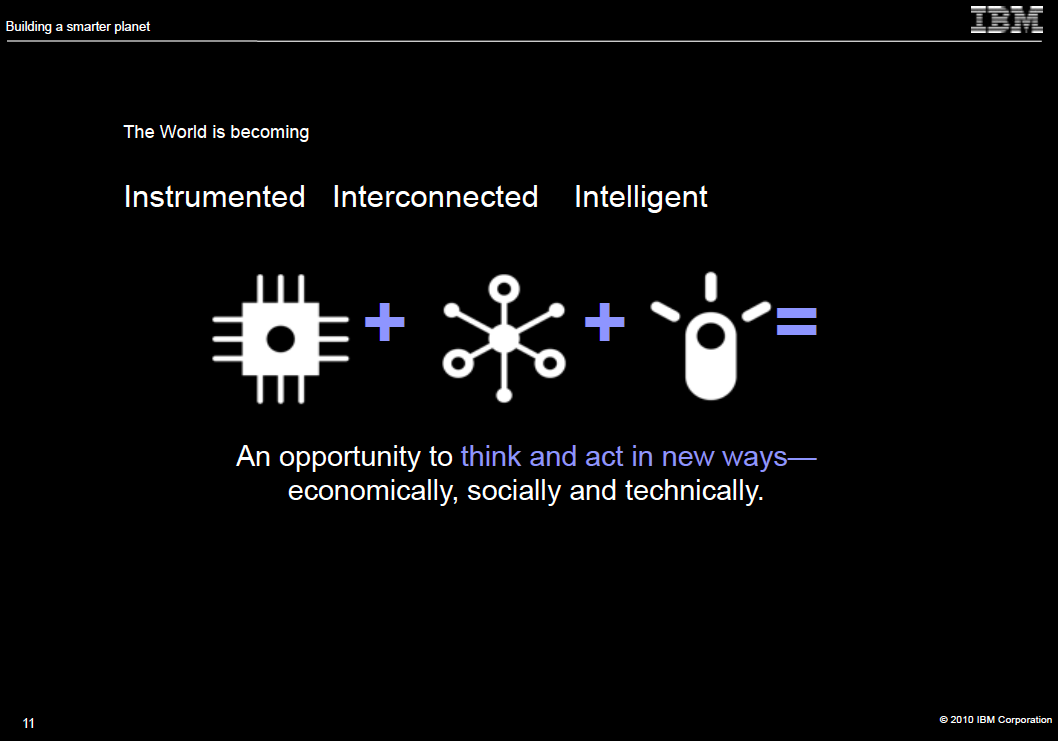
Sometime back, IBM summarized the information revolution as being something that will be enabled by the emerging trend of the 3 I’s. Technology is allowing everything to be instrumented and therefore automated and measured, its allowing everything to be interconnected and with all this data its allowing intelligence to make sense of everything and act on it in real time.

The 3 I's of IBM

The 3 I’s of IBM

The vision is described visually in this slide deck http://goo.gl/2tVDFk and is expounded upon by a professional communicator of IBM here http://goo.gl/bsKBxf so I wont belabour you with the merits of this great framework, rather I will proceed to make this suggestion, that the following trends is the last 5 years;

  • Drones
  • Robots
  • Autonomous Vechiles
  • Brain Computing Interfaces
  • Artificial Intelligence
  • Attempts to reproduce working digital models of human Neuro Anatomy and Machinery

require the edition of an additional I to the 3. That I is ‘Incarnation’. The word best summarises the fact that we are trying to provide a body to our AI to move and exist in the real world. It also captures the fact that we are trying to Anthropomorphise our software to make it seem more human and therefore easier to use and relate to and perhaps form emotional attachment. This incarnation is also now merging the real world and the virtual one, allowing an overlay of knowledge on the real world with technology like Augmented Reality or allowing machines a body to move and interact with the real world through robotics. I am sure the geniuses in IBM can take this concept further then I can.