Cloud challenges for Malaysia

You can’t have a discussion about cloud computing in Malaysia without a heated debate on security and risk.
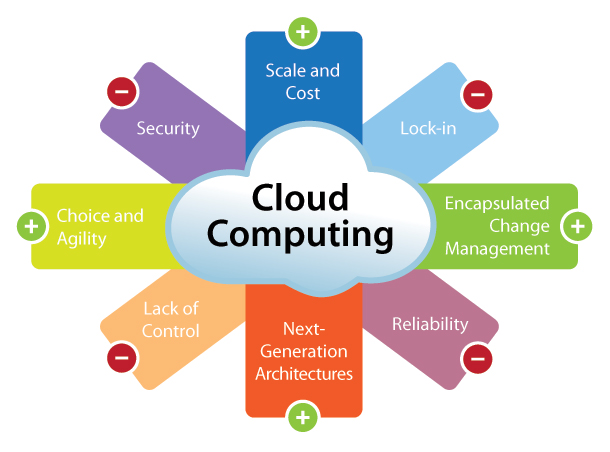
I have observed 2 root causes of the debate;

1. The cloud democratises large scale enterprise capability coupled with the ability to buy-as-you-need, even small businesses can now leverage on sophisticated enterprise grade IT. In the past, business could get away with low level talent enabling just basic IT services such as accounting, payroll and email. Now in this cloud enabled world of endless useful applications and networks like Facebook, sales force and google apps, even small to medium businesses are able to innovate and have IT capability on par with the global multinational titans. So a gap emerges, while the business units of a company can contract and outsource IT services equivalent to their larger counterparts, they don’t have access to the talent of these behemoths do to plan processes, policies, data governance, integration, architecture and security to manage this level of risk and exposure. The connected world is a two-edge sword, enabling unparalleled access to markets and communities while also increasing exposure to those with malicious intent. So companies can buy services on the cloud but not management. What is missing for Malaysian customers already sold on the commercial benefits of the cloud is someone they can trust and rely on to map their journey and steps to slowly migrate to this opportunity to get more with less.

2. Much of the IT leadership in the Malaysian corporate scene is dominated by technology management rather than actual information and intelligence. The former is the trusted resource to design, build and operate technology to provision assets to achieve limited information and automation goals but the later is a timely asset with an emerging demand. This new breed of CIO equipped with the latest technology and data science know-how and is ready to provide actionable insights to the business to gain a competitive advantage or address new market opportunities. Many vendors selling the cloud attempt to use language that resonates with the later but are selling components that still need to be pieced together by the former. So they end up running up against the wall of vested interest because they are asking the quarter master to reduce his/her scope.

I don’t have an all encompassing mitigation strategy at this point in time, but I suspect the solution will begin from driving more popular apps that will appeal to end users and providing more and more solutions on a Software As a Service or Business Process As a Service coupled by data integration services that will not leave users feeling siloed on your apps. Think about it, what kind of platforms and app stores can you build in your vertical industries that the current technology will enable, economically and securely.
 

A 4th “I” for IBM’s “The 3 I’s of Smarter Content”

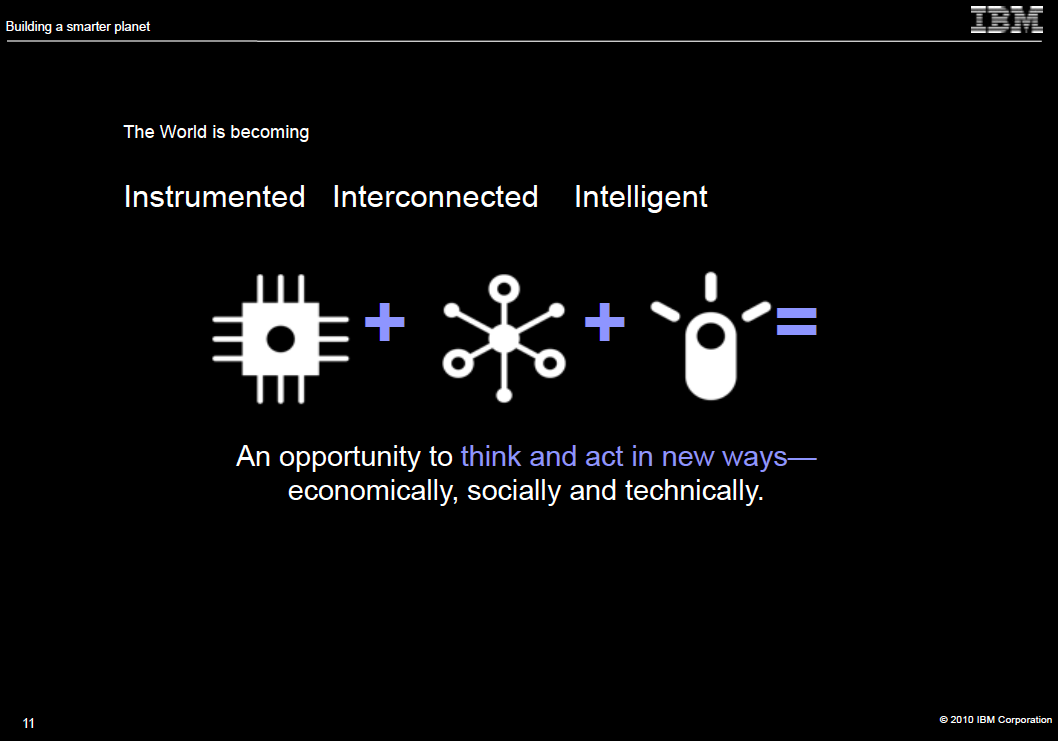
Sometime back, IBM summarized the information revolution as being something that will be enabled by the emerging trend of the 3 I’s. Technology is allowing everything to be instrumented and therefore automated and measured, its allowing everything to be interconnected and with all this data its allowing intelligence to make sense of everything and act on it in real time.

The 3 I's of IBM

The 3 I’s of IBM

The vision is described visually in this slide deck http://goo.gl/2tVDFk and is expounded upon by a professional communicator of IBM here http://goo.gl/bsKBxf so I wont belabour you with the merits of this great framework, rather I will proceed to make this suggestion, that the following trends is the last 5 years;

  • Drones
  • Robots
  • Autonomous Vechiles
  • Brain Computing Interfaces
  • Artificial Intelligence
  • Attempts to reproduce working digital models of human Neuro Anatomy and Machinery

require the edition of an additional I to the 3. That I is ‘Incarnation’. The word best summarises the fact that we are trying to provide a body to our AI to move and exist in the real world. It also captures the fact that we are trying to Anthropomorphise our software to make it seem more human and therefore easier to use and relate to and perhaps form emotional attachment. This incarnation is also now merging the real world and the virtual one, allowing an overlay of knowledge on the real world with technology like Augmented Reality or allowing machines a body to move and interact with the real world through robotics. I am sure the geniuses in IBM can take this concept further then I can.

Consider this before choosing a system for your hospital

putting

I once gave a talk called “How to manage your CIO” for CFOs and CEOs from the region in an event in Bangkok. My main premise was that the single biggest factor to consider when buying a system or systems for your hospital/hospitals is understanding your organisation and its IT / Informatics maturity and the vision of where you need to be in the next few years. Nothing revolutionary I know, it would even seem like it should be obvious – but you would be surprised how often healthcare providers don’t get this. So much effort and focus is spent on understanding technology, features and vendors before sufficient soul searching has been done to answer preliminary questions such as;

  1. what is going to be our business focus and differentiation over the next few years, ambulatory care?  wellness?
  2. can we ever picture ourselves as leveraging IT to unlock new capabilities and markets or is that too far fetched for now?
  3. are we looking to build a community? branches? regionally?
  4. will we build up internal IT capability or will we always be dependent on partners?
  5. do we know where we are in terms of IT maturity now? do we have a way to measure it and chart a course?
  6. will we be able to secure executive sponsorship and a competitive budget? how will we manage the BOD?

The answer to these questions have serious impact to the vendors and solutions a hospital should be choosing. The economics of Malaysia usually mean that we do not have sufficient buying power as a nation to demand customisation from mature technologies. So often buyers in Malaysia have to choose between reengineering their processes and informatics to conform to mature technology and workflows from proven overseas systems or to have something bespoked to their needs locally and risking the quality issues inherent to this option. Some vendors have strong systems but others have strong implementation skills – which is more important for your situation? Some hospitals lack the IT maturity and need a vendor who will come and tell them what to do and conform them to their image – others have such strong preferences and needs, they will be better suited to a vendor who listens and conforms. In my experience many customers do not understand themselves, thinking they are the latter when they are really the former – resulting in implementation deadlocks where they feel the vendor is not helping them to complete a task or make meaningful choices. The analogy I like to use is a golfer putting. A successful putter is one who is not only sufficiently practised but able to read the greens and choose the right stroke and approach to sink that ball.

Semantic Interoperability > Syntactic Interoperability

4 years ago when I took the Healthcare IT Portfolio of UMSC, I learned the horror of integration in healthcare, to get various bits of clinical information about a patient from its different Silos to the consolidated Medical Record. When most vendors spoke of integration, they were purely speaking on the level of syntactic interoperability, where protocols and middleware allowed for the flow of badly coded HL7 messages from one system to another. This process was prone to problems of version control, the lost of dimensions and context to the data and is an expensive and complex process. The biggest proof that this is a broken practice is that Clinical analytics was often not possible from the aggregated data. Most importantly, the machines pushing the data around were agnostic to its semantic meaning or context and therefore this limited ability to unlock automation and analytics that normally follows other industries that digitize their data.

So when I explored the possibility of semantic interoperability on top of syntactic interoperability, I was pointed to data dictionaries and codified medical knowledge and told that the only solution was getting Clinicians and practitioners to abstract and code data manually so that it was machine understandable. So I went on a quest, to look at the use of AI and Natural Language Processing to solve this problem, and was pleasantly surprised that IBM has developed some solutions on these principles and capabilities. Finally we can leverage IT for Semantic Interoperability and unlock the value of Clinical Analytics.


Questions after watching Corning’s Day of Glass

I wonder, in a world of ubiquitous, seamless, persistent & intuitive computing – will we finally have information symmetry or will new means of ensuring an advantage of asymmetry occur? If the 3D printing revolution does occur, and our fabrication of atoms really takes us into a post scarcity economy, then perhaps there will no longer be an incentive to maintain asymmetry of information – or will there? Perhaps a world of all information at your fingertips and no scarcity will be one where competitive advantage is derived from creative use of knowledge rather than knowledge itself.

I ponder this world the same way religious people ponder an afterlife.

Laissez faire capitalism is but a pipe dream.

Apologies for this Non HIT post, but these issues affect us all an post economic turmoil, its worth thinking about this. Economist who are usually champions of capitalism are also quick to point out some common weaknesses that have to be addressed.

Hirchman’s Exit vs Voice

This wonderful obituary to Albert Hirschman in the economist, summarizes his voting theory from his most famous book, “Exit, Voice and Loyalty: Responses to Decline in Firms, Organisations and States”. According to the theory, Mr Hirschman argued that people have two different ways of responding to disappointment. They can vote with their feet (exit) or stay put and complain (voice). Mr Hirschman raised some problems with the cult of exit. Sometimes, it entrenches the status quo. Dictators may rule longer if their bravest critics flee abroad (indeed, Cuba uses emigration as a safety valve). Monopolies may have an easier life if their stroppiest customers find an alternative.

So in disappointment, many give up ownership and no longer have influence to change the factors that brought about the disappointment.

Hardin’s Tragedy of the commons

In this well documented phenomenon first postulated by Garret Hardin in the journal science in 1968. Wikipedia summarizes the theory well;

“The metaphor illustrates the argument that free access and unrestricted demand for a finite resource ultimately reduces the resource through over-exploitation, temporarily or permanently. This occurs because the benefits of exploitation accrue to individuals or groups, each of whom is motivated to maximize use of the resource to the point in which they become reliant on it, while the costs of the exploitation are borne by all those to whom the resource is available (which may be a wider class of individuals than those who are exploiting it). This, in turn, causes demand for the resource to increase, which causes the problem to snowball to the point that the resource is depleted (even if it retains a capacity to recover). The rate at which depletion of the resource is realized depends primarily on three factors: the number of users wanting to consume the common in question, the consumptiveness of their uses, and the relative robustness of the common.[18]

In a nutshell, when a common resource has no ownership, there is little or no incentive to manage it.

Externalities

Externality as defined by Professor Jan Horst Keppler of the University Paris-Dauphine; “Externalities or external effects are goods that have an impact on welfare (positive or negative) that is not taken into account by the agent producing them” – I would have that this impact to cost or benefits are often left out in the transaction of buying and selling.

Often in a negative externality scenario, the market is unable to recognize the true cost of the good sold due to the lack of a feedback mechanism. Examples of this abound in environmental concerns – where the cost of the good does not factor in the cost of pollution or socio economic ills incurred to other anonymous stakeholders affected by this transaction.

So I’ve been thinking that the 3 issues mentioned above we see in capitalism have a common theme of a perversion of ownership. Sometimes what matters is not the same as what is valued in our selfish quest for utility and around incentives. In some parts of the world, culture plays a strong role to mitigate this. If there exist a culture of common ownership, then there will be a non monetary motivation to own and manage that which is subject to the perversion of our selfishness, apathy or greed. Another mitigating factor is information – when we truly understand true cost, or have constructs for collective ownership or a collaborative deep motivation to retain ownership despite disappointment, we can mitigate this natural inclination of the perversion of ownership. In any case, these issues inform me that there will always be a need for government and laissez faire capitalism is but a pipe dream.

The more sophisticated your users are…

“Our users aren’t sophisticated enough for such tools, is there a basic option?” 

The more sophisticated your users are, the less sophistication they need from their tools. 

DSC04661


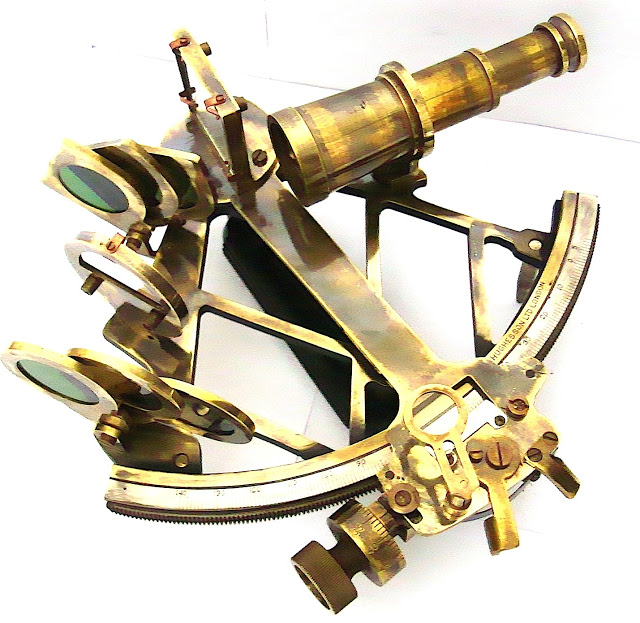
Think of the expert sailors of old, who navigated the seven seas with nothing but outdated print maps and a sextant. Expert level sailors today can still pull this off, but if you just got your first boat its probably going to look more like this;

500x407xoasis-bridge.jpg.pagespeed.ic.cYO2K8cI7e

One button fix all apps are usually needed by the less sophisticated users – which is ironic because these tools cost more as they require a lot of sophistication during the implementation. The modern CIO has to make a judgement call, if your users are simple you need sophisticated vendors, if your vendors are simple, you need sophisticated users.

monkey-typewriter-1

You will end up spending the money anyway – its either going to your payroll or to the contract with the vendors.

Zen: Beaten Paths reveal human behavior

An Architect (civil) friend told me a story about working around human behavior  that has stuck with me over the years and influenced my practice as an Architect of information systems.

The story is about an architect who was looking for a solution to the persistent problem of people not using sidewalks no matter how convenient they were. Eventually the foot traffic wore out new paths on the landscape and would be an eyesore.This architect had an idea, he would build all of his buildings, but defer the sidewalks. He would just plant grass. 6 months later he would come back and put sidewalks down where all the beaten paths emerged. By doing this he put the paths in the places that emerged from unpredictable trends of human behavior. This was the failure of all his counterparts, they were trying to predict those trends, and often got it wrong.

3184420588_9e6335b73e_b

The principle that I applied to my field of work is to leave interfaces and parts of information systems to the trends that emerge, rather than trying to dictate something that people wont use. The modern enterprise is a combination of policies, processes and services that have been designed top down, but they should meet grassroots movements and trends halfway, for maximum impact.

The story also carries a fashionable new big data lesson – if we can understand trends we can capitalize on actual human behaviour, rather than our inaccurate traditions of conjecture.

Mobility in Healthcare

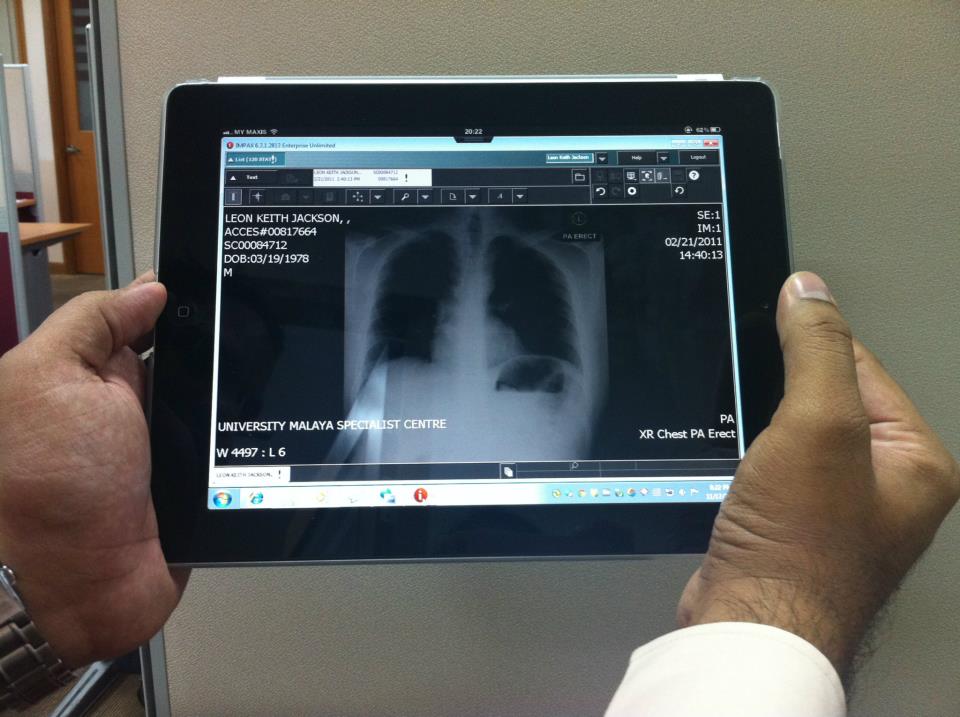
Mobility enables real time consumption and contribution of critical medical data to the clinicians at the point of care. Mobility is more than a convenience or trend, it can enable quicker documentation reducing errors and provide critical decision support to Clinicians at the point of care.